4 - Software Business Performance Management
Giving leadership a unified view of software adoption, recurring revenue, and operational performance.
Business Background
Sensormatic's Software as a Service (SMaSS) platform represented one of the company's early strategic software initiatives. Unlike traditional hardware sales, the platform generated recurring subscription revenue while strengthening the overall retail loss-prevention ecosystem.
Leadership needed a reliable way to measure software adoption, customer growth, recurring revenue, and the business value being created.
The required information existed across multiple enterprise systems but had never been brought together into a single executive view.
The Opportunity
The Director responsible for the software business needed more than operational reports.
He needed a management system capable of answering fundamental business questions:
Is software adoption growing?
Are installations being converted into paying customers?
Are recurring revenues meeting expectations?
Where are operational bottlenecks delaying growth?
Is the software business becoming a meaningful contributor to the company?
Those answers required integrating information from multiple organizations rather than relying on a single reporting system.
Solution
I designed an executive software performance management system that consolidated operational, financial, customer, and regional information into a unified reporting framework.
The solution integrated data from:
MicroStrategy
Power BI
JD Edwards
Regional Excel reporting
Customer monitoring systems
Account and billing information
The framework measured:
Customer adoption
Regional growth
Active installations
Billed subscriptions
Annual recurring contract value
Global software footprint
Design Approach
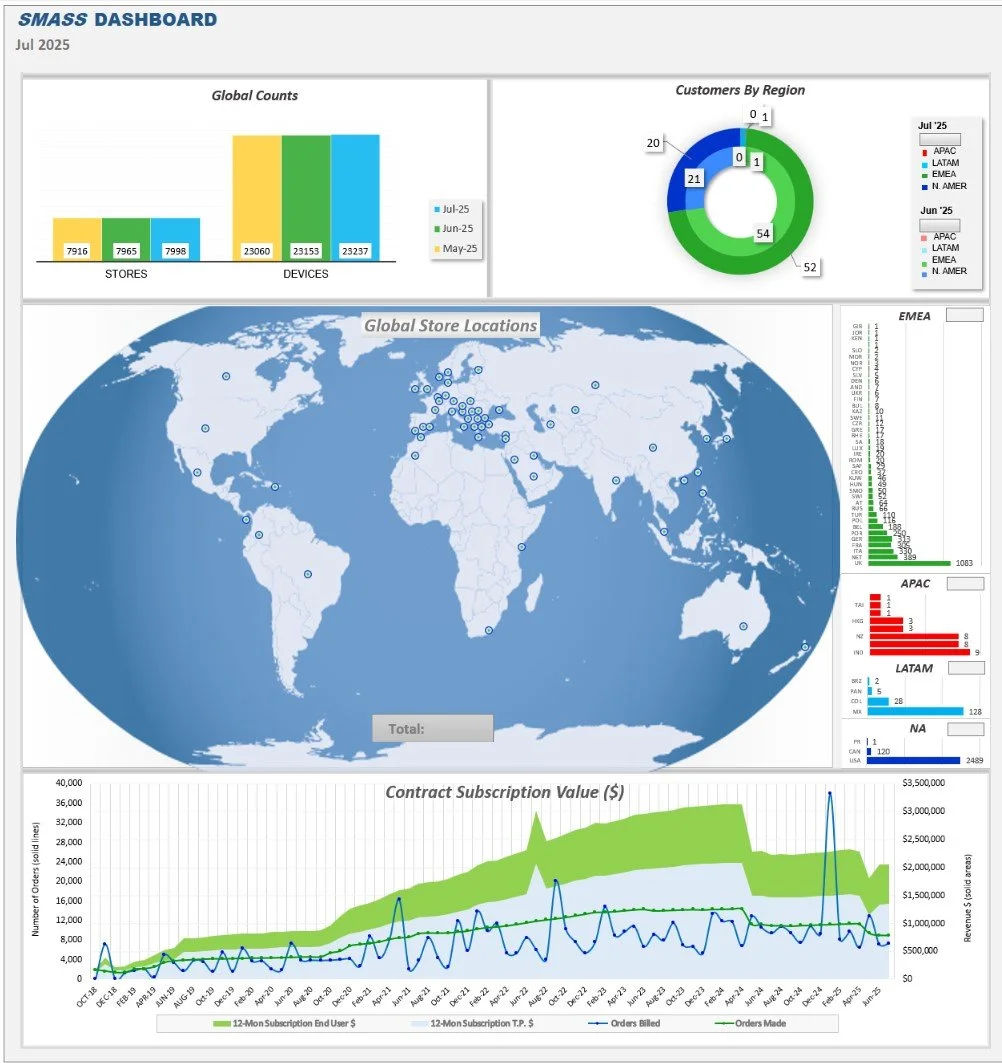
Rather than presenting disconnected operational reports, I designed a single executive dashboard that summarized software performance across product adoption, geographic expansion, customer activity, recurring revenue, and operational health.
Each visualization answered a different executive question while contributing to a unified picture of overall business performance.
One visualization I'm especially proud of was the global footprint map. Instead of listing customer locations in tables, it immediately communicated worldwide adoption by showing active deployments across countries. Likewise, the recurring revenue chart connected installations, billing activity, and annualized contract value so leadership could quickly identify operational gaps that affected revenue recognition.
The objective wasn't simply to report software metrics.
It was to give leadership confidence that the software business was becoming a sustainable, measurable, and growing part of the company's future.
Organizational Impact
The framework became the primary reporting system used by software leadership to monitor business performance.
It supported executive reviews by providing visibility into customer adoption, recurring revenue, billing performance, and operational execution.
The reporting system:
Unified information from multiple enterprise systems
Improved visibility into global software growth
Helped identify billing delays affecting recurring revenue
Demonstrated a growing recurring software revenue stream supporting the company's strategic software initiative.
Continued supporting the organization after my departure